The government shutdown of 2025 didn’t just close offices, freeze paychecks, or strain families. It revealed how far Congress’s political culture has deteriorated—a culture where communication is no longer meant to inform the public, but to manipulate it. There’s something deeply unsettling about how members of Congress talked to the American people during the fight over the continuing resolution. Political messaging has always carried spin, but this time truth, integrity, and constitutional duty were spun out of the picture almost entirely.
Instead of straight talk, Americans were fed dueling storylines engineered for tribal loyalty rather than understanding. Each side cherry-picked talking points to rile up its base. They accused each other of holding the government hostage. They insisted their party alone represented the “real America.” Each claimed the other was sabotaging the nation.
The shutdown didn’t just hurt the citizens and inconvenience America and the world—it exposed how our representatives have broken faith with the very notion of public service. They traded nuance for slogans, policy for posturing, and the rest of us are left paying the price.
What Broke This Time
Shutdown brinkmanship has been reckless for years, but this round exposed something deeper: truth has become negotiable. Congressional communication wasn’t aimed at the whole country; it was targeted at internal loyalty markets. The public wasn’t the audience—it was the ammunition.
Democrats, for all their flaws, largely explained what was being debated and what they were willing to compromise. They defended a policy position—not a conspiracy theory.
Republican messaging, especially from leadership aligned with President Trump, leaned on provably false claims, inflammatory accusations, and emotionally loaded language designed to provoke fear and resentment. The tactic was obvious: frame the shutdown as a moral emergency caused entirely by Democrats, even when the text of the continuing resolution contradicted key claims.
The public wasn’t asked to understand.
The public was asked to react.
And millions did just that.
Congressional Lies & Manipulation Have Consequences
Three toxic messaging tactics dominated the shutdown:
- Inventing motives instead of citing policy.
- Blaming without acknowledging shared responsibility.
- Presenting speculation as fact and outrage as evidence.
We watched elected officials feed citizens pre-cooked interpretations instead of raw information—a hallmark of rhetorical authoritarianism. When the public stops hearing facts and only hears which tribe is “betraying” them, democratic legitimacy cracks.
That crack widened in October.
Truth-Tracker: Major False or Misleading Messaging Claims During the Shutdown
This section may be uncomfortable, but comfort isn’t the mission here. These fact-checks are documented and sourced from non-partisan verification outlets.
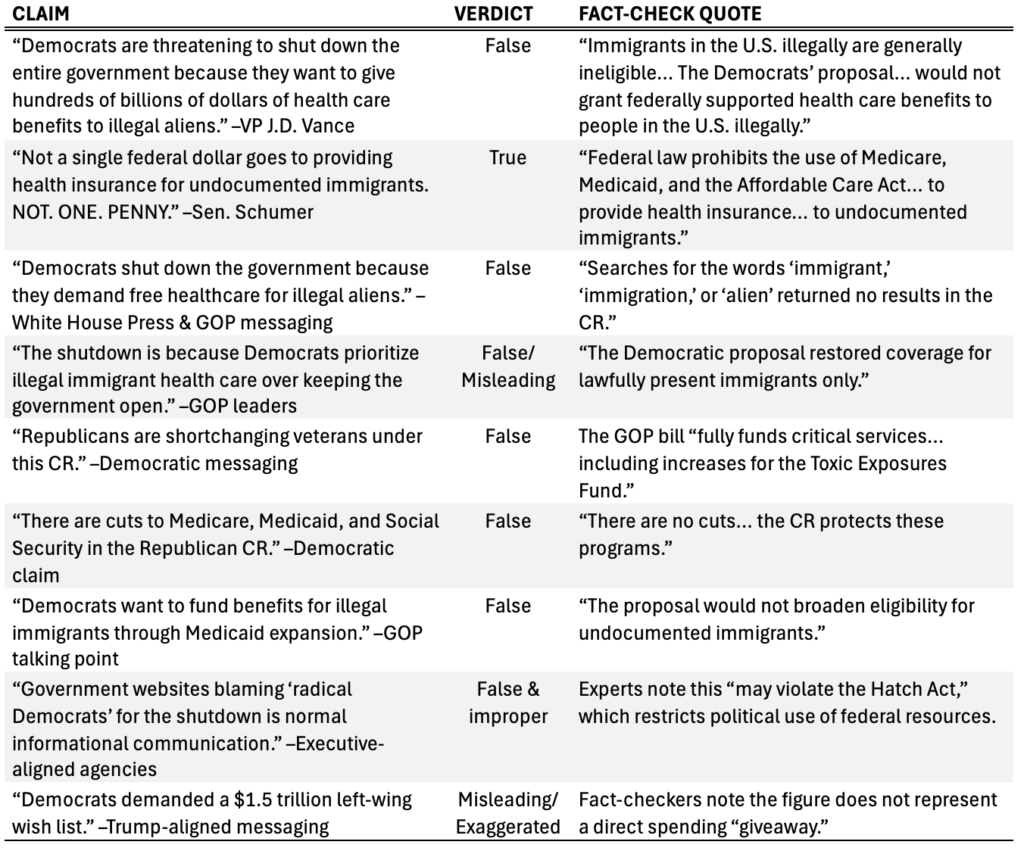
This isn’t about who “won.” It’s about who told the truth.
What This Shutdown Exposed About Our Political System
A few realities rose to the surface:
Trust fractured.
If representatives use taxpayer-funded platforms to deliver partisan talking points, how can the public trust them to act as public servants instead of political operatives?
Misinformation weaponized.
The “healthcare for illegal immigrants” narrative wasn’t a misunderstanding—it was a deliberate, repeated tactic. By amplifying it, Republican leadership tapped into longstanding fears.
Consequences minimized.
Instead of grappling with how cuts or delays harm real people, much of the shutdown discourse revolved around optics and leverage.
A call for real civic engagement.
The shutdown proved that Americans must pay closer attention—not just to the headlines, but to the legislation itself. This isn’t theater. It’s the machinery of government.
The Public Is Starting To See Through Congressional Lies—Finally
The shutdown cracked the veneer on the Republican messaging machine. Voters who followed the details saw the gap between what was said and what was verifiably true. Ideology can be debated forever; the text of a bill cannot.
A democracy cannot endure when a major political party treats truth as optional.
Citizens are not props. Patriotism is not a marketing slogan.
National strength does not grow from frightened followers—it grows from informed adults.
The shutdown laid bare the rot in how Congress communicates. Narratives replaced explanation. Sound bites replaced substance. Meanwhile, real people—federal workers, families relying on public services, low- and middle-income Americans—were left in limbo.
If the system is to be repaired, it starts with the citizenry. We have to demand more than cynical talking points. We must insist on transparency and accountability, and on messaging rooted in fact rather than fear. If we fail to do that, the brokenness we’ve seen in 2025 won’t be an exception—it’ll be the blueprint.
The Hard Question
How can citizens trust Congress when communication is no longer meant to explain, but to trigger?
Trust isn’t rebuilt through slogans or theatrics. It’s rebuilt through candor, accountability, and courage.
If Congress refuses to fix itself, the public has only one option left: to outperform it.
That begins with refusing to be manipulated.
That the Republic may stand,
Patriotic Quill