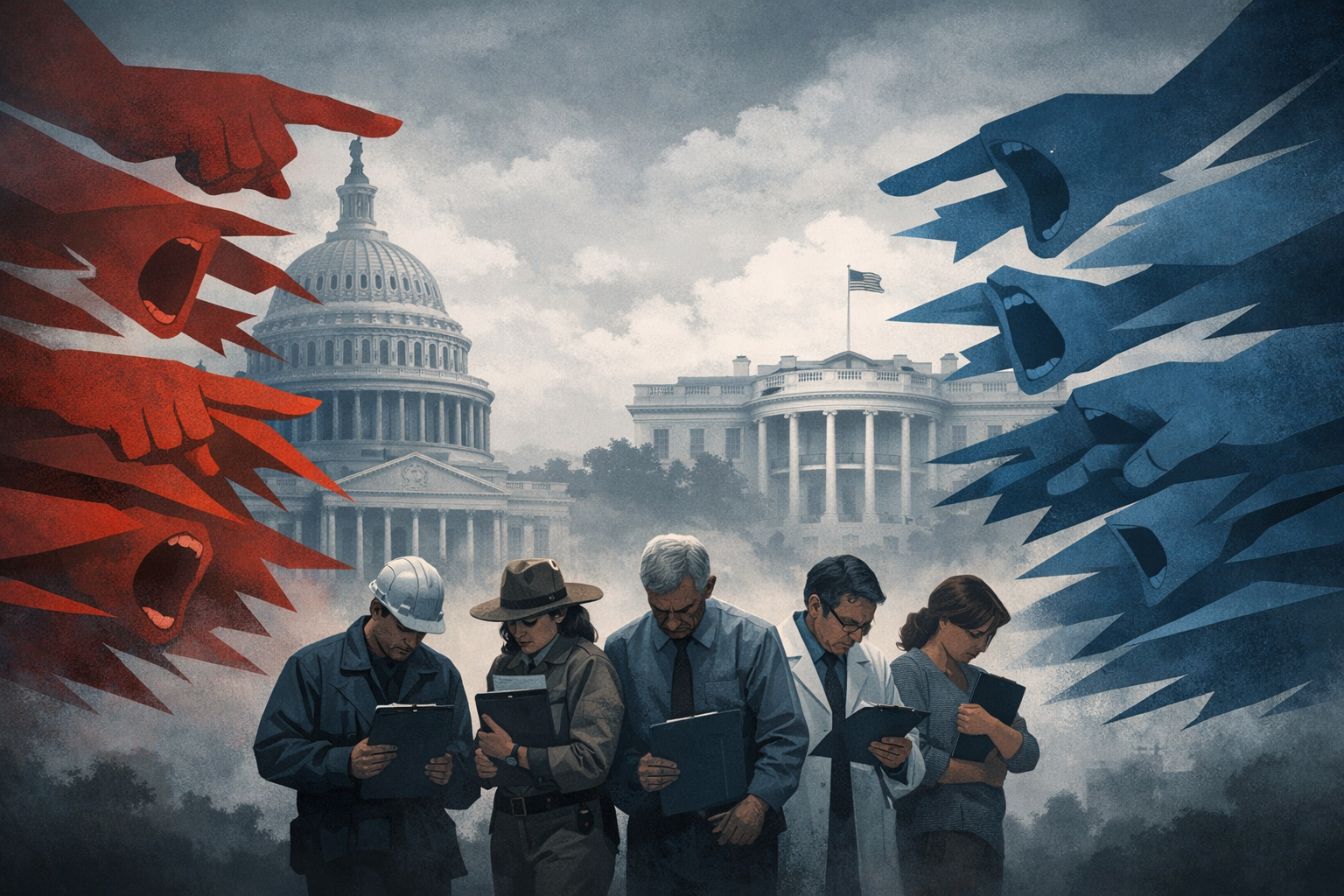
In U.S. employment law, a hostile work environment exists when conduct is severe or pervasive enough that a reasonable person would find it intimidating, abusive, or disruptive to their ability to perform their job. It doesn’t require physical threats. It doesn’t require slurs. It doesn’t require that a single individual be named.
Persistent humiliation, collective disparagement, intimidation, threats of arbitrary punishment, or messaging that signals employees are inherently suspect rather than professional can all qualify. Crucially, the legal standard focuses on effect, not intent.
Federal workers are employees. And just because their employer happens to be the state, the dynamics of power, authority, and coercion don’t disappear because the setting is political. Furthermore, a leader’s claim that remarks were rhetorical, exaggerated, or politically motivated doesn’t negate their impact on federal workers or the workplace.
Rhetoric as Management
Over the past several years, rhetoric from senior government leadership has increasingly treated civil servants not as neutral professionals but as obstacles to be defeated. Entire agencies—including the FBI, DOJ, CDC, and election administration offices—have been publicly described as “corrupt,” “rigged,” or fundamentally untrustworthy by those at the highest levels of power. Career officials have been accused, in broad terms, of sabotaging elected leadership or acting as part of an internal “deep state,” a phrase repeatedly used in rallies, interviews, and official communications. Calls to “clean house,” “gut” agencies, or remove large numbers of career employees have been made publicly, often without distinction between documented misconduct and lawful professional disagreement or statutory obligation.
This isn’t conjecture. Senior officials have publicly accused federal law-enforcement agencies of systemic corruption and political subversion—claims made in speeches, interviews, and official statements that were broad enough to implicate entire institutions rather than specific cases. In response, agencies such as the FBI and DOJ have issued rare public defenses of their workforce, emphasizing adherence to the law, ethics, and nonpartisanship. Similar accusations have been directed at public-health agencies during the pandemic, at election administrators following certified elections, and at regulatory bodies enforcing statutory mandates—often framed as proof of disloyalty rather than professional disagreement.
This language isn’t experienced as abstract political debate by the people it targets. It’s heard by employees whose performance reviews, job security, and personal safety depend on leadership that publicly questions their integrity, motives, and legitimacy.
When those who are doing the accusing control budgets, appointments, reassignments, firings, investigations, and public narrative, then the rhetoric becomes managerial. It communicates expectations, signals risk, and alters behavior. Federal workers understand that defiance—even in the form of good-faith professional judgment—may carry consequences.
That’s precisely how hostile environments function.
If This Were a Private Company
Consider the same behavior in a private-sector setting.
A CEO repeatedly describes employees as corrupt, lazy, disloyal, or dangerous. Senior leadership publicly threatens mass firings, hints at purges, and frames entire departments as enemies of the organization. These statements are amplified through media and internal communications and defended as “honesty” or “tough leadership.”
In any private company, this would trigger immediate consequences: HR investigations, legal exposure, shareholder concern, and board intervention. The conduct wouldn’t be defended as leadership. It’d be recognized as creating a hostile work environment.
In recent years, companies have faced lawsuits, regulatory action, and executive removals for far less sustained and less public behavior. Corporate leaders have been disciplined or ousted after publicly disparaging employees, threatening retaliation for dissent, or fostering cultures of intimidation—sometimes through a handful of emails, leaked meetings, or social-media posts. High-profile cases in the technology, entertainment, and retail sectors have shown that when leadership rhetoric signals hostility, collective suspicion, or punishment for disagreement, boards and courts treat it as a governance and workplace failure, not a branding choice.
When similar rhetoric comes from government leadership and targets federal workers, however, it’s routinely dismissed as politics. That distinction doesn’t hold up—legally, ethically, or operationally.
The Measurable Damage
The effects of this rhetoric are visible and compounding.
Morale erodes when employees are told their integrity is suspect by default. Expertise is withheld when technical judgment is framed as disloyalty. Early retirements accelerate. Recruitment falters. Institutional memory drains away quietly.
In 2025 alone, multiple federal agencies reported unusually high attrition tied to leadership turnover, public disparagement, and uncertainty about mission continuity. Entire departments have lost experienced personnel at rates that directly affect service delivery, from agricultural support programs to public-health preparedness.
Public-facing workers—election officials, scientists, archivists, park rangers, inspectors—have reported increased harassment from members of the public who mirror leadership rhetoric. When officials describe agencies as corrupt or illegitimate, some citizens take that as permission to threaten the people who staff them.
This isn’t theoretical harm. It’s operational damage to the functioning of government.
A state that depends on professional administration can’t afford to normalize leadership behavior that undermines its own workforce.
A Line Past Presidents Understood
American presidents have long criticized bureaucracy. They’ve argued about inefficiency, waste, and reform. But historically, there was a clear distinction between attacking systems and questioning the legitimacy or loyalty of the people operating them.
President Dwight D. Eisenhower warned forcefully about institutional excesses while simultaneously affirming the professionalism and constitutional role of the civil service. In his 1953 State of the Union Address, he emphasized the need for “an efficient, honest, and devoted civil service.” Even as he cautioned against the accumulation of unchecked power, he didn’t portray civil servants as adversaries. His concern was structural—not personal.
President Ronald Reagan, despite his skepticism of government expansion, maintained the same line. In his First Inaugural Address, he criticized the government’s scope, not the integrity of those who served within it. Later, he publicly acknowledged that the federal workforce consisted of “men and women who serve quietly and faithfully, without public applause.” Reform was framed as managerial, not moral.
President Barack Obama, amid fierce debates over healthcare, financial reform, and national security, likewise focused criticism on outcomes and structures. In 2009, he framed the issue plainly: “The question we ask today is not whether our government is too big or too small, but whether it works.” At no point did he broadly portray career civil servants as disloyal or illegitimate.
These distinctions mattered. They preserved continuity across administrations, insulating governance from personal power struggles and affirming that civil servants serve the Constitution and the public—not a party or a leader.
History offers repeated warnings about what happens when that line collapses.
In multiple 20th-century democracies that slid toward authoritarianism, such as Weimar Germany, leaders first framed professional civil servants as disloyal elites or internal enemies. Once public trust in institutions was eroded, loyalty tests replaced competence, constitutional constraints weakened rapidly, and institutional resistance to executive overreach collapsed from within.
The erosion didn’t announce itself as authoritarianism. It arrived disguised as strength.
“They Work for the Public” Isn’t a Defense
A common rebuttal is that federal workers serve the public and must accept scrutiny. That is true—and beside the point.
Accountability doesn’t erase an employer’s duty of care. Soldiers, teachers, firefighters, and law-enforcement officers all serve the public. We still recognize that leadership which demeans, intimidates, or collectively disparages them degrades performance, ethics, and trust.
The existence of laws such as the Hatch Act underscores this reality. These protections exist precisely because federal workers are vulnerable to political coercion and retaliation. The law recognizes that professional neutrality can’t survive in an environment of sustained political intimidation.
Public service isn’t consent to abuse.
A Call to Conscience
Congress, agency leadership, and oversight bodies have too often chosen silence, treating rhetorical abuse as a political inconvenience rather than what it is: a failure of leadership and employer responsibility.
That choice has consequences.
This blog began with a workplace standard because that’s exactly what’s at issue. Federal agencies are workplaces. Civil servants are employees. When those with authority publicly demean, threaten, or delegitimize the people they supervise, they create conditions that meet the definition of a hostile work environment anywhere else in American life. The fact that the employer is the government doesn’t suspend that reality—it heightens its stakes.
A democracy can’t function if the people tasked with administering laws are publicly degraded by those sworn to uphold them. A civil servant can’t remain professional if loyalty is rewarded over competence. And a republic can’t remain stable when leadership behavior that would trigger intervention in any private organization is excused at the top as mere politics.
This isn’t about shielding federal workers from criticism. Accountability is essential. But accountability isn’t humiliation, and oversight isn’t intimidation. Normalizing this conduct corrodes institutions from the inside out, quietly replacing professional judgment with fear and constitutional duty with personal allegiance.
The question isn’t whether this rhetoric is effective politics. The question is whether a government that tolerates a hostile work environment for its own workforce can credibly claim to be governed by law rather than by personality.
Silence answers that question too.
That the Republic may stand,
Patriotic Quill