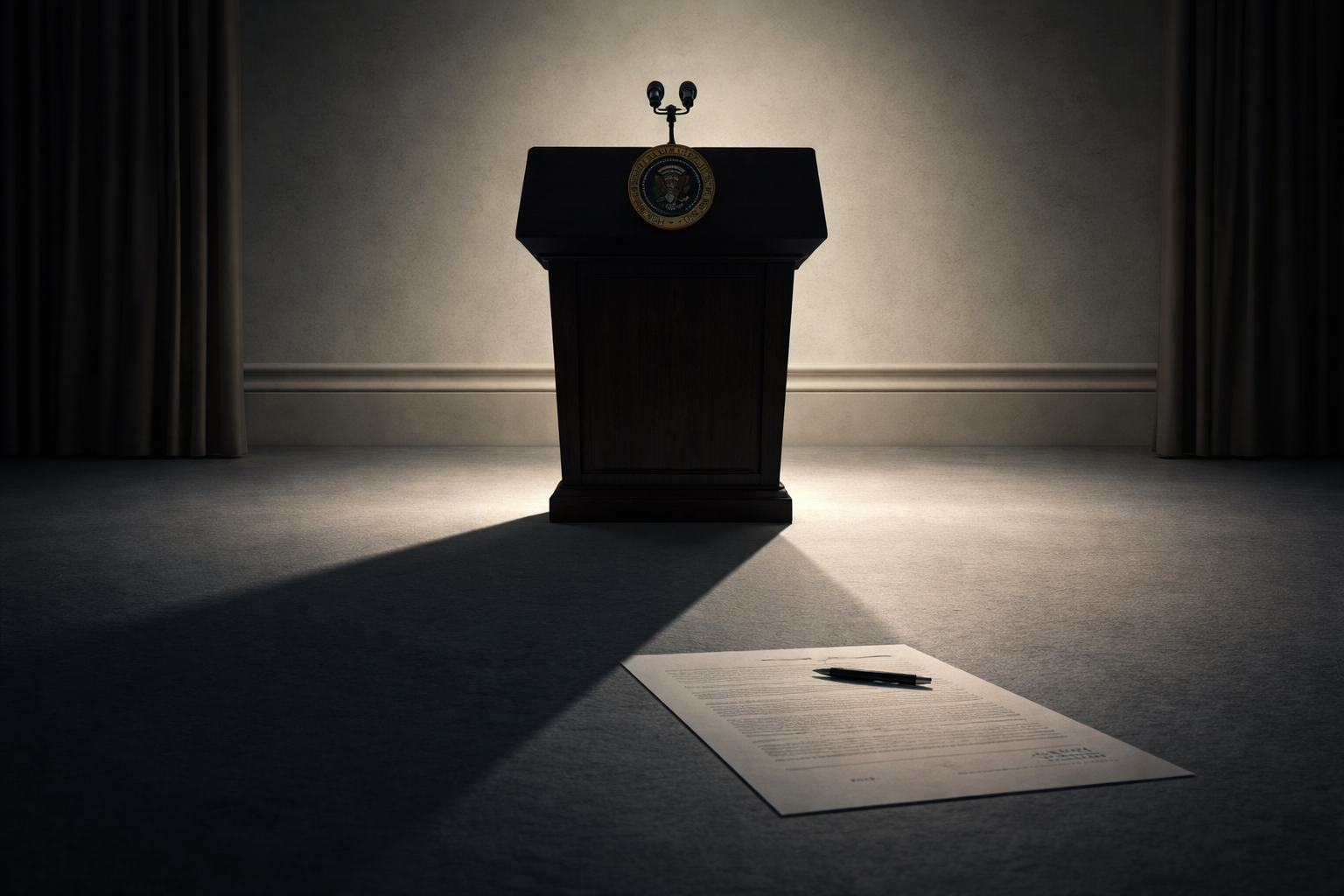
In the American constitutional system, the president doesn’t merely speak as a citizen or politician. He speaks as the Commander in Chief, the head of the executive branch, and the country’s primary signaler of national intent. For most of the republic’s history, presidents understood this distinction instinctively. Their words were measured not because they lacked conviction, but because they respected the force those words carried—the dangerous power of implied orders.
That restraint has weakened. In its place is a growing comfort with specificity, grievance, and suggestion delivered publicly—often without formal instruction, written order, or legal framing. The result isn’t clarity, but something more corrosive: implied command.
This shift raises a question that can’t be avoided. Is this a deliberate method of governance, or a failure to appreciate the consequences of presidential speech? Either answer should concern anyone who cares about democratic durability.
The Weight of Commanded Speech
In hierarchical systems, words from the top don’t drift harmlessly into the air. They move downward with consequence.
Military officers, federal agency leaders, intelligence officials, law enforcement commanders, and career civil servants are trained to read intent upward. They’re rewarded for initiative, penalized for hesitation, and constantly evaluated for responsiveness and loyalty. In that environment, a president doesn’t need to issue a formal order for action to follow. A comment, a criticism, or an expressed preference can be enough.
This isn’t a flaw in the system; it’s a known feature of command. That’s why past presidents treated public language with care.
Dwight D. Eisenhower, having commanded millions of troops in war, was famously cautious. He understood that loose language creates operational consequences. John F. Kennedy learned during the Cuban Missile Crisis that tone, phrasing, and timing could escalate conflict even when no order was given. Richard Nixon’s “madman” theory was controversial precisely because it weaponized ambiguity—and even then, it was aimed outward at adversaries, not inward at domestic institutions.
More recently, Barack Obama, despite expanding executive authority in other areas, was careful to separate rhetoric from instruction when addressing the military and intelligence community. Even controversial policies were accompanied by formal directives, legal justification, and process.
The point isn’t that these presidents were flawless. It’s that they grasped something basic: the Commander in Chief can’t speak casually without consequence.
When Expression Becomes Expectation
What’s changed this year isn’t bluntness alone. It’s the collapsing boundary between expression and instruction.
Public statements now regularly include specificity about targets, threats, preferred actions, and institutional frustrations—aired not through formal channels, but through speeches, interviews, and online posts. These statements may be followed by no written directive at all. And yet, action follows.
This creates the implied order problem.
An implied order is never signed. It leaves no paper trail. It’s deniable by design. Yet it’s felt keenly by those beneath the president, who must decide whether restraint will be read as professionalism or defiance.
The safest response becomes anticipatory compliance: acting not on law or instruction, but on perceived presidential desire.
That’s how governance drifts away from statute and toward atmosphere.
Intentional or Careless—and Why the Outcome Matters More Than the Motive
Defenders of this style often offer two explanations. Neither is reassuring.
If this approach is intentional, implied orders become a way to bypass legal constraint and institutional resistance. No formal directive means no judicial review, no congressional oversight, and no clear line of accountability. Power moves, but responsibility blurs.
If it’s careless, the danger may be greater. A president who doesn’t understand how words propagate through command structures effectively delegates authority to interpretation. Decisions are made by inference rather than instruction, and consistency gives way to improvisation.
The motives differ. The result does not.
In both cases, authority migrates away from formal process and into the shadows of interpretation.
Contemporary Consequences Without a Single Smoking Gun
The harm doesn’t require a dramatic incident to be real.
Federal agencies adjust enforcement priorities based on perceived preference rather than written policy. Military leaders balance professional obligation against public loyalty signals. Civil servants weigh adherence to statute against the risk of being labeled obstructive. Foreign governments parse presidential language for cues about American resolve or retreat—sometimes reacting before policy is clarified.
None of this requires a shouted order or a constitutional crisis. It happens quietly, through incentives.
Over time, the rule of law isn’t overturned; it’s sidelined. What matters isn’t what’s written, but what’s inferred.
Consider a recent, real-world scenario:
The president publicly criticizes a category of behavior as a threat to national order and expresses frustration that “nothing seems to be happening.” No executive order follows. No statute is cited. No formal directive is issued to the relevant agencies.
Within weeks, enforcement patterns shift.
Regional offices adjust priorities. Supervisors begin asking different questions. Field personnel report informal pressure to “take a harder look” or “be less hesitant.” Career officials understand the message clearly enough: expectations have changed, even if the law has not.
When concerns are raised internally, responses are vague. No one can point to an order—only to statements. When asked publicly, the administration can accurately say no directive was given.
This is how implied orders function. Nothing illegal is announced. Nothing explicit is commanded. And yet behavior changes across the system.
The danger isn’t that enforcement occurs. It’s that the basis for action becomes inferred presidential desire rather than written law or formal instruction. Accountability dissolves because responsibility is distributed across interpretation. No single actor can be blamed. Everyone is merely “responding to the tone.”
Historical Warnings Without Alarmism
History offers many examples of republics that didn’t fall through coups or sudden tyranny, but through erosion. Leaders governed increasingly through suggestion, spectacle, and loyalty signaling. Institutions adapted. Resistance softened. Formal procedures remained on paper, while real decisions migrated elsewhere.
The American system was designed to resist this through formality: written orders, clear chains of command, civilian control bounded by law, and accountability enforced through documentation. When speech replaces structure, those safeguards weaken.
This isn’t an argument about ideology. It’s an argument about method.
Historians’ Note on Civil–Military Restraint
Historians of American civil–military relations, including Samuel Huntington and Richard Kohn, have emphasized a core norm that sustained the republic even during crisis: clarity of command paired with political restraint.
Civilian control of the military was never meant to operate through hints, grievances, or public nudging. Presidents were expected to issue lawful orders and accept responsibility for them. Military leaders were expected to execute those orders—or refuse them if unlawful.
When civilian leaders blur this line, they place military professionals in an untenable position. Officers are forced to choose between strict obedience to written authority and perceived loyalty to unspoken expectations.
Kohn warned that this gray zone is where professionalism erodes—not through coups, but through gradual accommodation. Huntington argued that ambiguity politicizes the officer corps by forcing it to interpret political intent rather than execute policy.
The system held as long as presidents respected that boundary.
Have We Been Here Before?
We’ve seen implied orders before—but never this normalized, public, and domestically focused.
Lincoln occasionally spoke broadly during the Civil War, but he governed under explicit congressional authorization and issued extensive written orders, accepting responsibility for extraordinary actions.
Franklin D. Roosevelt used rhetoric aggressively during World War II, but his governance rested on massive legislative backing. When actions crossed constitutional lines, they were later acknowledged as such, not dismissed as misunderstandings.
Nixon’s “madman” posture comes closest conceptually, but it was aimed outward at foreign adversaries and used sparingly. It wasn’t a general mode of domestic governance.
During the McCarthy era, insinuation and pressure destroyed careers without formal charges—but this dynamic operated largely outside the presidency, not as a governing style of the Commander in Chief.
What distinguishes the present moment is the combination of peacetime normalization, inward-facing signals aimed at domestic institutions, and plausible deniability functioning as a feature rather than a risk.
That mix is new in American history.
Why That Distinction Matters
If this were merely another crisis moment, history might reassure. Instead, history warns that systems fail fastest when abnormal behavior becomes routine and no longer requires justification.
The American presidency was designed to be powerful, not suggestive. When suggestion becomes the primary mechanism of control, law recedes and loyalty fills the gap.
That’s not how republics fall loudly.
It’s how they thin out quietly—until formal authority still exists, but no longer governs.
A Call to Those Who Still Bear the Weight
This moment doesn’t place responsibility on the president alone.
Senior military officers, agency heads, senior advisers, legal counsel, and professional staff carry an independent obligation—to the Constitution, not to inference. Advising restraint is not disloyalty. Asking for clarity is not obstruction. In the military, refusing to act on unlawful implied orders isn’t insubordination; it’s duty.
History judges institutions not by how quickly they anticipate power, but by how faithfully they insist on lawful process.
The danger facing the republic isn’t that a president speaks forcefully. It’s that the immense power of presidential speech is no longer handled with care. Words once treated as instruments are now too often treated as impulses.
A constitutional system survives not only on laws, but on restraint—especially from those entrusted with command. When restraint disappears, decline rarely announces itself. It advances quietly, carried on sentences that were never meant to be orders, but were treated as such all the same.
That the Republic may stand,
Patriotic Quill
Editor’s Note:
This essay examines the constitutional danger of implied orders issued from the highest office. For those who carry the responsibility of acting on—or resisting—such signals, a companion letter addresses the professional duty of restraint and clarity within government institutions.