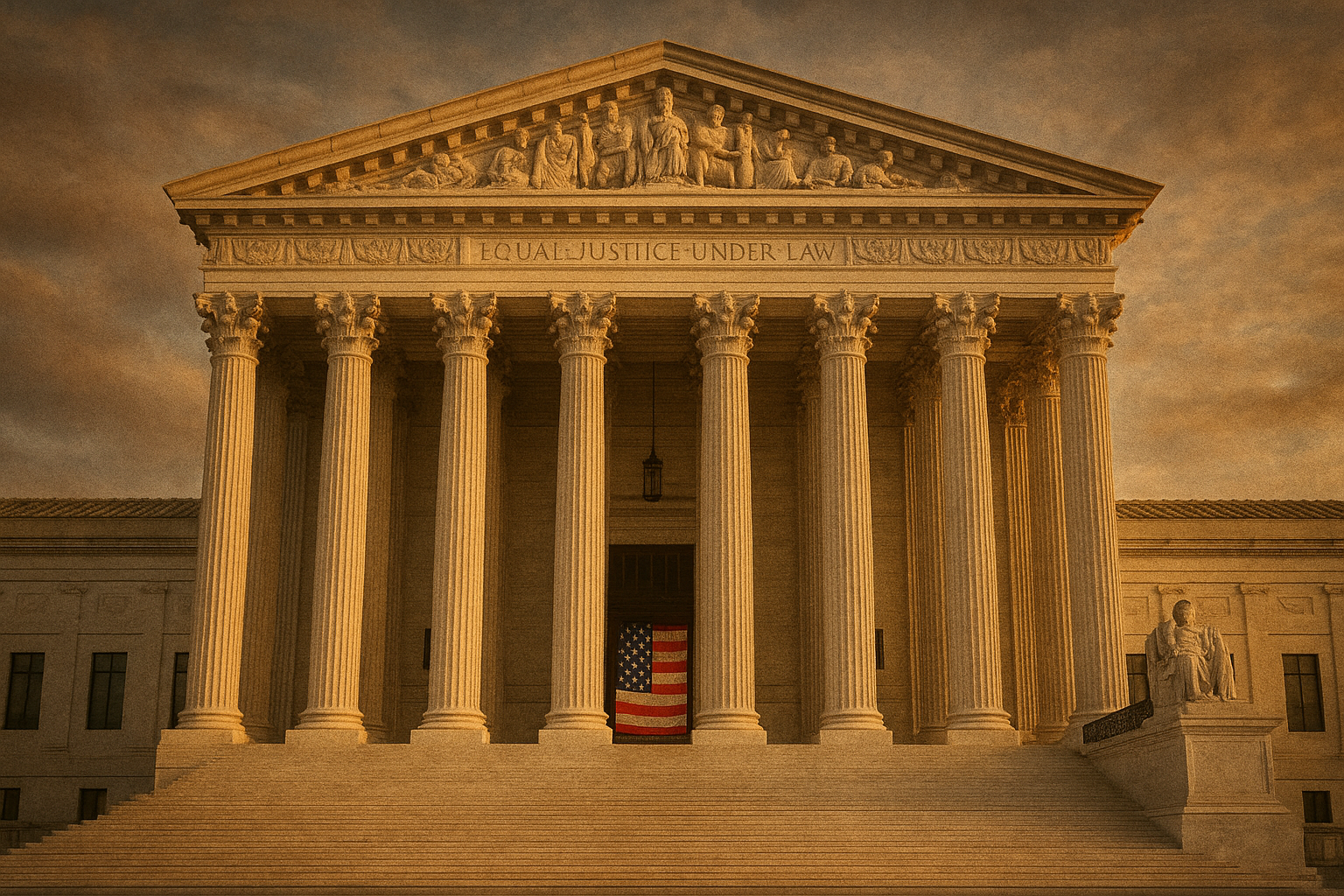
Honorable Justices of the Supreme Court,
When a nation begins to doubt its courts, it doubts itself.
The rule of law is not a slogan carved in marble—it is a covenant between citizens and the state. It promises that reason will prevail where passion fails, that truth will be judged by evidence, not by anger. Yet that promise now trembles.
Across the country, confidence in the Supreme Court has fallen to historic lows. Partisan rhetoric fills the air; ethical controversies cloud the bench; and citizens, unsure of whom to trust, begin to question whether justice still speaks with one voice. What we face is not simply disagreement over decisions, but the corrosion of belief that law can still stand above politics.
If the American people come to believe that justice bends toward politics, then the foundation of our democracy will begin to fracture from within.
The Judicial Crisis
The judiciary was meant to be our nation’s ballast—the branch least touched by the tides of ambition. Yet today, that ballast seems to be taking on water. The courts face a legitimacy crisis not because the Constitution has failed, but because we have allowed politics to seep into the very forum where politics was meant to stop.
Recent years have seen headlines filled with ethical controversies, financial entanglements, and perceived conflicts of interest among those entrusted to interpret the law. Every revelation—whether proven, exaggerated, or misunderstood—chips away at the public’s trust. And without trust, the law becomes a contest of will, not of principle. This perception is not a partisan problem; it is a constitutional one.
The Court cannot compel obedience through force or decree—it commands only through legitimacy. And legitimacy dies the moment citizens believe that outcomes depend less on reason than on ideology.
A free society cannot endure when citizens believe justice depends on influence, wealth, or proximity to power.
Yet that is the image too often cast: privilege over justice, politics over integrity, loyalty over truth. Each imbalance—each tilt toward self-interest—diminishes not just a decision, but the very idea that law stands above men.
In recent terms, the Court has, in several high-profile cases, appeared to turn back rather than move forward—reversing or weakening precedents once thought settled. Such reversals remain rare across the sweep of judicial history, yet their visibility magnifies their impact. When the nation’s highest tribunal seems to retreat from its own rulings, it signals uncertainty where there should be stability. And when citizens begin to doubt that the law’s foundation is firm, they start to wonder whether obedience itself is optional.
The Constitutional Role of the Court
The Supreme Court was not designed to be a partisan instrument, nor a moral compass for shifting times. Its charge is to interpret, not to invent; to safeguard the balance of power, not to influence it. Yet every era tests that restraint, and ours is no different.
The temptation to wield the bench as a corrective to perceived political wrongs is strong—but history reminds us that when justice bends to ideology, both law and liberty fracture together.
As Hamilton wrote, the Court “has no influence over either the sword or the purse.” It commands neither armies nor budgets. It depends entirely on the trust of the people and the cooperation of the other branches to give its judgments force. That dependence is not weakness—it is the purest form of accountability.
It ensures that power rests not on popularity or wealth, but on integrity and restraint. When the Court forgets that its authority is moral before it is legal, it ceases to be the guardian of the Constitution and becomes merely another political instrument.
Judicial independence is not a shield for arrogance; it is a duty of humility. The robe confers authority, not infallibility. When rulings read more like manifestos than judgments, the Court ceases to be the interpreter of the Constitution and risks becoming its editor. The line between those two roles is where republics live or die.
What History Teaches
History has little patience for those who assume their institutions are unbreakable.
In the waning days of the Roman Republic, courts that once checked ambition became instruments of it. When law bowed to politics, no constitution could hold back the tide of tyranny.
Centuries later, in the turmoil of revolutionary France, justice claimed moral purity but lost moral restraint—the guillotine replaced the gavel, and order collapsed under the weight of its own righteousness.
Even our own history warns us. During Reconstruction and the Jim Crow era, courts often failed to defend equal justice under law, preferring convenience to courage. Each failure carried a cost measured not in theory but in lives.
The lesson is constant:
When justice becomes political, politics becomes lawless. A republic survives only when its judges remember they serve not the moment but the Constitution that outlasts it.
A Call to Conscience
Honorable Justices of the Supreme Court, you hold in your hands the nation’s quiet faith. It is not a faith in perfection, but in principle—that even in division, the law will stand firm. Protect that faith. The Constitution entrusted you with neither popularity nor power, but stewardship.
The Court is the last refuge of law in a nation where the other branches are subject to passion and politics. If the judiciary falls to partisanship, there will be no place left for the people to turn.
Justice must remain blind not because truth is hidden, but because power is tempting. You are entrusted not merely to interpret the Constitution, but to embody its spirit—to be an example of restraint in an age of indulgence, of fairness in an age of fury.
The people are watching—not to see whether they agree with your rulings, but whether they can still believe in your oath.
If the Court becomes just another political battlefield, no citizen will trust the law. And when trust dies, justice falters—and the Republic trembles.
That the Republic May Stand,
Patriotic Quill