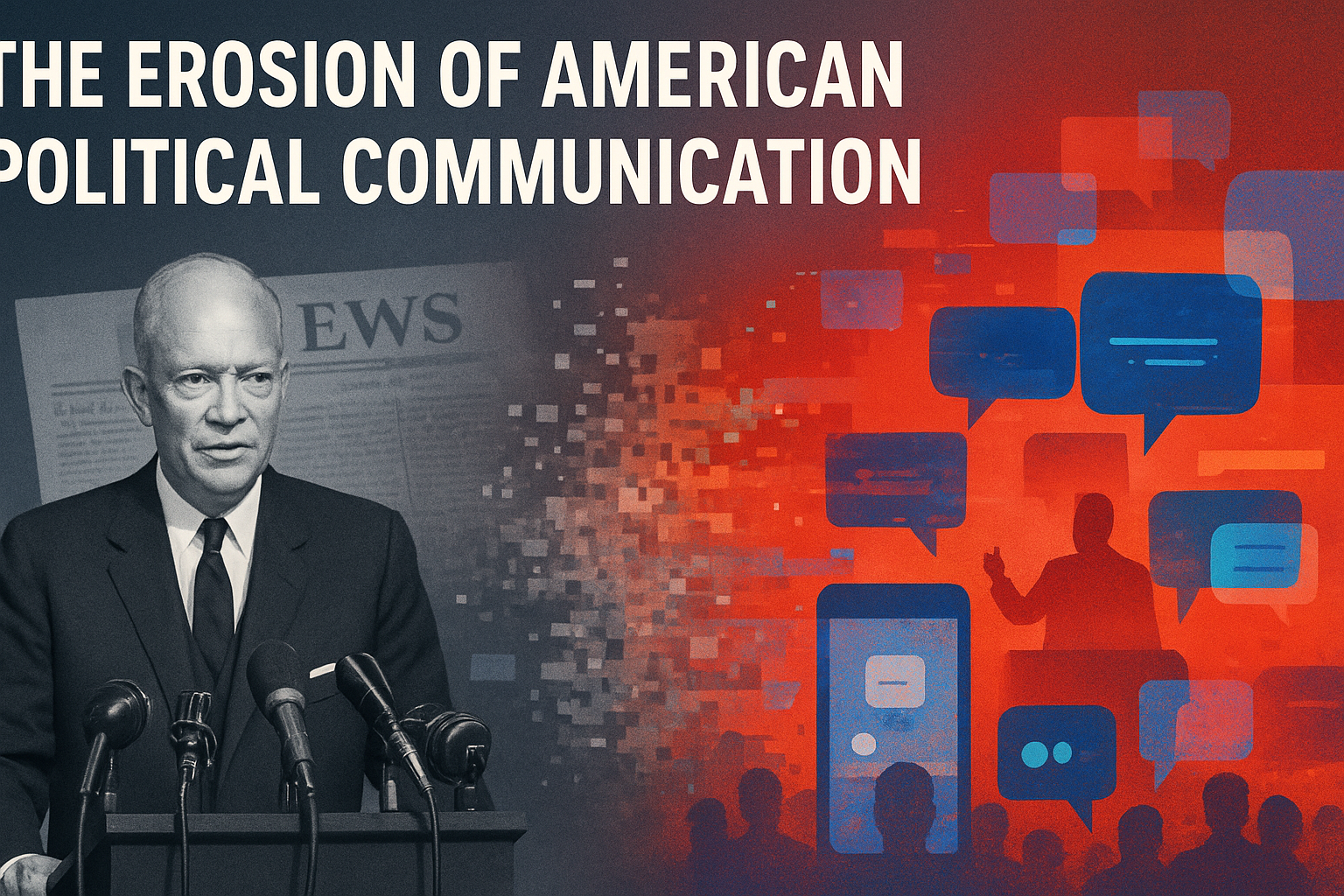
Across American history, presidents and political leaders have relied on communication not only to justify policy, but also to persuade, negotiate, and build public trust. That tradition has eroded. This erosion of political communication in modern America is no accident; it’s the predictable result of deepening polarization, media fragmentation, and a willingness to treat rhetoric as a tool for influence rather than illumination. Debate has given way to messaging wars. Persuasion has been replaced by mobilization. The goal’s often not to inform a broad public but to consolidate a loyal faction.
This shift did not appear overnight, and it’s not the product of a single party or person. As the political system has become more polarized and more dependent on perpetual campaigning, communication has drifted toward division and control. What once encouraged citizens to argue, reason, and deliberate now often encourages them to retreat into hardened camps.
This analysis examines the erosion of political communication across administrations and why certain contemporary patterns more closely resemble the techniques commonly seen in authoritarian political movements than the norms of democratic leadership. By focusing on seven core communication methods, we can trace the gradual departure from a rhetoric rooted in shared civic principle toward one increasingly shaped by narrative dominance, grievance, and loyalty politics—a trajectory that raises serious questions about the future of democratic discourse.
The Erosion of Political Communication: A Broad Overview
Political communication in the United States has never been static. From the early republic onward, presidents have tried to balance persuasion, partisanship, and public expectation. The dominant trend over the last century, however, has been a gradual shift from rhetoric aimed at persuading a broad public to rhetoric designed to mobilize and divide.
Mid-20th-century presidents such as Dwight D. Eisenhower, John F. Kennedy, and Ronald Reagan appealed to national unity and shared civic purpose, even when pursuing sharply contested agendas. Their speeches relied heavily on reasoned argument, institutional respect, and an assumption that a wide American audience could be brought into conversation about the nation’s direction. This didn’t eliminate partisanship—far from it—but persuasion remained the core of the craft.
By the 1990s, political communication was reshaped by professionalized campaign strategies, the rise of partisan media, and the demands of the 24-hour news cycle. Bill Clinton’s presidency marked a turning point: televised messaging became more strategic, more reactive, and more tightly correlated with polling and rapid-response operations. The incentive structure began shifting from consensus-building to political survival within an increasingly fragmented media landscape.
The presidencies of George W. Bush and Barack Obama deepened this transformation. Each relied on sophisticated media operations and digital outreach, and each governed in an atmosphere of accelerating polarization. Although both faced misinformation and partisan media ecosystems that distorted their agendas, neither president adopted messaging that regularly rejected verifiable facts or portrayed institutional checks as inherently illegitimate.
The sharp break comes with Donald Trump. His communication style diverges from the long-standing democratic norm of persuasion and instead prioritizes narrative dominance, personal loyalty, and the discrediting of any institution that challenges him. This pattern resembles the communication strategies common to authoritarian political movements, where emotional mobilization and control of the informational environment outweigh appeals to shared civic principle.
This evolution—uneven, cumulative, and shaped by changing technologies—sets the stage for the seven communication methods that follow. Each method reveals how the country moved from persuasion toward something more combative, more fragmented, and more corrosive to democratic discourse.
Seven Communication Methods: A Framework for Analysis
To understand the full scope of the erosion of political communication, it’s useful to break down the communication strategies used by politicians into seven distinct methods. These methods serve as the skeleton for understanding how political messaging has changed over time. They also allow us to evaluate modern rhetoric without partisan framing. When applied consistently, these categories reveal how Trump’s communication style departs sharply from the historical range of American presidents.
That departure matters because his approach represents the first time in American history that a president has embraced authoritarian-style rhetoric in such an open and consistent manner.
I. Ethical Frameworks
How politicians justify their actions: Are they using honest means to achieve their goals, or are they relying on dishonest means to shape public perception?
Political leaders have always struggled with the tension between transparency and political survival. But there is a discernible historical evolution in how presidents justify their actions and communicate truth—or distortions—to the public.
Historical Evolution
In the early and mid-20th century, presidents tended to frame themselves as custodians of public truth, even when reality fell short. Eisenhower publicly emphasized the importance of honest government and national unity; Kennedy spoke of candor and civic responsibility, especially during crises like the Cuban Missile Crisis, when he released extensive information to justify his decisions.
Even presidents who later faced scandals maintained rhetorical commitments to truth as a democratic value. Richard Nixon, for example, insisted—at least publicly—that transparency and integrity were essential to governing, even while Watergate unfolded behind closed doors. Reagan often emphasized the moral necessity of honest leadership, despite later controversies like Iran-Contra. Clinton openly acknowledged the need for truthful communication even as he parsed language during the Lewinsky scandal. Bush framed his administration’s communication after 9/11 in terms of duty, clarity, and moral responsibility, even as intelligence failures around Iraq later came to light.
The pattern is consistent: presidents did not always live up to their own standards, but they affirmed that truth mattered and that dishonesty, when exposed, demanded public accountability. The standard often failed in practice—but the norm was still acknowledged.
Trump’s Break with the Norm
With Trump, we see a sharp break from this tradition. His communication strategy doesn’t merely bend facts or rely on strategic omissions. It openly and repeatedly deploys falsehoods as political weapons. Instead of affirming truth as an ideal—even symbolically—Trump attacks the very concept of shared reality. Branding mainstream journalism as “fake news” is not just a complaint about coverage; it is a deliberate effort to delegitimize independent verification. This is the hallmark of an authoritarian communication style: truth becomes whatever the leader says it is, and any institution that contradicts the leader becomes an adversary.
Examples
- Trump’s repeated false claims of widespread election fraud after the 2020 election.
- His false statements about the size of his 2017 inauguration crowd, contradicted by photographs, transit data, and the National Park Service.
- Repeated falsehoods about COVID-19’s severity in early 2020, including claims that it was “totally under control” and would “disappear… like a miracle,” despite internal warnings to the contrary.
II. Communication Strategies
How politicians garner support: Do they focus on persuasion—attempting to build agreement through reasoned arguments and appeals to shared identity—or do they rely on polarization, dividing the electorate into “us” vs. “them” to mobilize their base?
Historical Evolution
For much of American history, persuasion was the bedrock of presidential communication. Abraham Lincoln appealed to the “better angels of our nature” during the Civil War, grounding his arguments in moral reasoning and constitutional principles. Theodore Roosevelt combined vigorous rhetoric with appeals to national purpose, urging Americans to take up a shared “strenuous life.” Franklin D. Roosevelt (FDR) delivered fireside chats designed not to inflame but to reassure, explaining complicated policies in plain terms to build democratic consensus.
The shift begins in the late 20th century. As cable news emerged, the incentives around political communication changed. Clinton blended persuasion with targeted messaging designed to appeal to narrow demographic slices—an early sign of the data-driven segmentation that would become common. Bush relied more on value-based appeals and post-9/11 unity, but his team also recognized the power of mobilizing core supporters through emotionally charged issues. By the Obama era, digital media turned persuasion into micro-persuasion, delivering individualized messages while simultaneously amplifying partisan divides through algorithmic sorting. Polarization became a structural feature of the political environment, reinforced by talk radio, cable networks, and online echo chambers.
Presidents still spoke the language of unity, but the communication landscape increasingly rewarded division. The terrain shifted before Trump arrived; he simply exploited it with unprecedented intensity.
Trump’s Break From the Norm
Trump doesn’t just lean into polarization—he uses it as a governing principle. Instead of persuasion aimed at broad constituencies, his communication strategy centers on maintaining loyalty within a specific base by defining others as threats. This goes beyond negative campaigning or partisan contrast. It reframes fellow Americans, institutions, and sometimes entire groups as adversaries.
This “us vs. them” framing is a hallmark of authoritarian-style rhetoric: power is consolidated by creating internal enemies, eroding trust in neutral institutions, and rewarding loyalty over consensus-building. Past presidents engaged in partisan fights; Trump orients his communication around division itself. In this framework, unity is not a goal—combat is.
Examples
- Trump’s defining immigrants broadly as criminals, including the well-documented “they’re bringing drugs, they’re bringing crime, they’re rapists” line from his 2015 campaign launch, which continued to echo throughout his presidency.
- His labeling the press “the enemy of the people,” a phrase historically associated with regimes that attempt to delegitimize independent sources of information.
- His repeated assertions that criticism of him is equivalent to an attack on the nation itself—framing political disagreement as national betrayal.
III. Institutional Respect vs. Power Grabs
How politicians show their commitment to the institutions of democracy—Congress, the judiciary, and the press: Do they respect their authority, or do they seek to undermine or bypass them in order to consolidate power?
Historical Evolution
Presidents have always wrestled with the country’s core institutions, sometimes harshly, but the prevailing pattern was a grudging respect for their constitutional role. Thomas Jefferson attacked the Federalist judiciary but still recognized its authority. Andrew Jackson ignored a Supreme Court ruling in the Worcester case, a serious breach, yet he did not attempt to weaken or restructure the Court as an institution. FDR tested the limits with his court-packing proposal, but when public resistance mounted, he accepted the boundary and worked within the system. Nixon denounced the press and tried to resist Congress, but when the Supreme Court ordered him to release the Watergate tapes, he complied. Clinton endured impeachment proceedings he viewed as politically driven but did not contest Congress’s right to carry them out. Obama criticized the Court over Citizens United and sparred with Congress on nominations, but he did not question either body’s constitutional legitimacy.
These conflicts were often sharp, and some presidents pushed beyond prudence. Yet a shared assumption held: the institutions were essential and would outlast the presidency.
Trump’s Break From the Norm
Trump departs from that traditional range in both tone and intention. His communication consistently frames institutions not as constitutional counterweights but as adversaries whose legitimacy depends on whether they support his goals.
His claims that elections are legitimate only when he wins, his portrayal of the judiciary as partisan when it rules against him, and his assertions that the press is an “enemy” rather than a watchdog move beyond the historical clashes of prior presidents. The difference is not disagreement but delegitimization—a shift from contesting decisions to questioning the validity of the institution itself.
This represents a clear alignment with authoritarian-style messaging: institutions are legitimate only when they align with the leader’s interests, and their independence is treated as a threat rather than a constitutional safeguard.
Examples
- Trump’s refusal to accept the legitimacy of the 2020 election results.
- His repeated personal attacks on federal judges who ruled against his policies, including the travel-ban litigation.
- His public calls for the impeachment or removal of officials—judges, election administrators, inspectors general—whose actions contradicted his political aims.
IV. Integrity and Accountability
How politicians show their commitment to honesty, integrity, and personal responsibility: Do they accept the consequences of their decisions, or do they deflect blame and obscure the truth?
Historical Evolution
Every administration encounters failure, scandal, or public backlash. While presidents have often tried to reframe events or minimize political damage, most eventually acknowledged responsibility in some public-facing way. Kennedy accepted fault for the Bay of Pigs invasion. Lyndon B. Johnson owned the consequences of the Vietnam policy when he announced he would not seek re-election. Reagan took responsibility for failures in oversight during the Iran-Contra affair, even as he contested aspects of the narrative. Clinton admitted wrongdoing in the Lewinsky scandal after months of denial. Bush publicly accepted responsibility for intelligence failures regarding weapons of mass destruction in Iraq and later acknowledged federal missteps in the response to Hurricane Katrina. Obama stated plainly that “we screwed up” after the botched roll-out of the Affordable Care Act website.
These acknowledgments varied in sincerity, timing, and political calculation, but they fit a long-standing expectation that the presidency carries a duty to own errors, at least in principle.
Trump’s Break From the Norm
Trump’s communication diverges sharply from that tradition. His approach centers on narrative control rather than responsibility. Errors, controversies, and policy failures are consistently framed as the fault of staff, the media, political rivals, or external forces.
His messaging mirrors authoritarian-style communication pattern: admitting error is cast as weakness, and verifiable facts that contradict the leader’s narrative are reframed as partisan attacks..
Examples
- Trump’s refusal to accept any responsibility for his role in the events leading to the January 6 attack.
- His frequent public statements shifting blame for administrative failures—ranging from pandemic management to policy rollouts—onto advisers, agencies, or political opponents.
- His dismissing fact-checks, inspector-general findings, and inconvenient reporting as “fake,” thereby rejecting external accountability mechanisms.
V. Policy Substance vs. Rhetorical Flash
How politicians address issues: Do they prioritize substance—policies that can be measured and debated—or do they focus on rhetorical flash, using emotional appeals and dramatic framing to overshadow policy detail?
Historical Evolution
For most of American history, presidents communicated policy by grounding their arguments in the specifics of legislation or national challenges. Lincoln’s speeches on slavery and union were steeped in constitutional and moral reasoning. FDR’s fireside chats walked the public through the mechanics of the banking system and the goals of New Deal programs. Eisenhower offered measured explanations of the Cold War strategy. Even in more modern administrations—Kennedy’s New Frontier, Johnson’s Great Society, Reagan’s economic reforms—rhetorical flourishes were paired with an effort to explain or defend concrete policies.
The late 20th and early 21st centuries introduced a gradual shift. Clinton relied heavily on polling and crafted messages emphasizing empathy more than detail. Bush framed complex foreign and domestic policies in simplified moral language (“good vs. evil”). Obama used soaring rhetoric but consistently paired it with long-form policy arguments. The broad trend was toward more polished presentation, but the underlying expectation that presidents justify their policies in substantive terms persisted.
Trump’s Break From the Norm
Trump’s approach diverges from this pattern. His political communication leans heavily on theatrical presentation—rallies, slogans, and emotionally charged language—often overshadowing substantive policy debate. Complex issues are distilled into catchphrases that mobilize supporters without clarifying underlying tradeoffs or consequences. The result is a communication style where rhetorical flash consistently overshadows policy detail.
This style aligns with communication patterns seen in illiberal political movements: emotional resonance and repetition of simplified slogans are prioritized over substantive policy explanation.
Examples
- Trump’s slogan-driven framing of immigration (“Build the Wall”) offered a dramatic and emotionally charged message rather than a detailed policy argument.
- His rally speeches routinely emphasized loyalty, grievance, and threat over policy substance, leaving issues like healthcare, foreign policy, or national budgeting largely unaddressed in substantive terms.
VI. Media and Technology
How politicians use media and technology: Do they use these tools to foster informed debate, or do they exploit them to control narratives, manipulate facts, and attack critics?
Historical Evolution
Presidential use of media has always adapted to the dominant technology of the era. FDR mastered radio, using his fireside chats to explain complex policies in plain language and build trust. Kennedy leveraged television’s visual power to project calm leadership during crises and to make substantial policy arguments accessible to the public. Reagan, a former actor, pioneered the modern era of media-savvy politics by blending scripted messaging with emotional appeal while still maintaining a public expectation of factual grounding.
The 24-hour news cycle of the 1990s changed that equilibrium. Clinton worked the system relentlessly, using rapid-response communication to manage scandal and narrative control. Bush governed during the rise of cable-driven political polarization, as outlets such as Fox News and MSNBC amplified partisan narratives. Obama’s campaigns marked the first sophisticated use of social media as a civic-minded mobilization tool—one that emphasized direct communication but still respected traditional press briefings and institutional norms.
By the 2010s, social media created a landscape where politicians could bypass institutional gatekeepers altogether. The line between communication and manipulation grew thinner as immediacy became the norm.
Trump’s Break From the Norm
Trump’s use of media and technology pushed this trend into new territory. His communication strategy relied on direct, unfiltered broadcasts to his supporters through platforms like Twitter—often multiple times a day and frequently at odds with verified facts. This approach allowed him to set the narrative, preempt scrutiny, and define political conflict on his own terms.
Trump did not just use social media to bypass traditional press channels; he used it to delegitimize mainstream outlets, elevate partisan alternatives, and shape the information environment in real time. The goal was not simply communication but narrative dominance. This pattern mirrors practices associated with illiberal movements: controlling the information space becomes central to consolidating political power and weakening independent scrutiny.
Examples
- Trump’s use of Twitter to attack opponents, promote unverified claims, and bypass traditional press briefings.
- His repeated labeling of mainstream outlets such as CNN and The New York Times as “fake news,” paired with the elevation of partisan or fringe media sources aligned with his narratives.
VII. Leadership vs. Demagoguery
How politicians project their leadership role: Is leadership rooted in principle and democratic engagement, or does it drift toward demagoguery, where power is consolidated through fear, grievance, and division?
Historical Evolution
Throughout U.S. history, presidents have varied in temperament and style, but most recognized that leadership required appealing to shared civic values rather than inflaming social divides. FDR used his rhetoric to calm public anxieties during the Depression and to prepare the public for collective sacrifice during World War II. Eisenhower governed with a steady, unifying posture, warning against the dangers of political extremism in his farewell address. Even polarizing figures like Nixon, despite deep flaws and abuses of power, presented their leadership as grounded in law, order, and national cohesion rather than open appeals to mass resentment. Reagan blended ideological conviction with optimistic language about American unity, and Obama consistently framed political engagement as a way to bridge divisions rather than widen them.
These leaders disagreed sharply on policy, and many engaged in hard-edged politics, but the prevailing expectation was that presidents should temper divisions rather than harness them for personal power.
Trump’s Break From the Norm
Trump’s political communication marks a significant departure from that tradition. His rhetoric often taps into grievance, social division, and suspicion of outsiders, and he frequently frames political conflict as a personal struggle between himself and a set of enemies—domestic and foreign. This approach elevates the leader at the center of the political universe and asks supporters to view challenges to the leader as threats to the nation itself.
Instead of orienting citizens toward shared democratic principles, his rhetoric narrows the political community to those who support him and casts dissenters as disloyal or corrupt. This pattern aligns with the classic dynamics of demagoguery: the leader claims exclusive representation of “the people,” portrays opponents as illegitimate, and mobilizes emotion rather than shared civic principle—a hallmark of authoritarian political movements.
Examples
- Trump’s calls for supporters to challenge the 2020 election results, framed as a battle to save the country from unnamed subversion.
- His attacks on Republican lawmakers who criticized him, treating dissent not as a normal function of democratic life but as a betrayal of the leader.
The Role of Parties in the Erosion of Political Communication
The transformation of political communication in the United States did not originate with a single figure or a single party. Both major parties have contributed—at different times and in different ways—to the environment that shapes politics today. The Republican Party under Trump has leaned most heavily into rhetoric that breaks with traditional democratic norms, but the broader trajectory that enabled this shift was decades in the making.
Democrats have also adapted to—and sometimes accelerated—polarizing dynamics. The party’s increasing reliance on identity-based appeals (messaging aimed at specific demographic groups rather than a broad national audience), heightened contrasts with Republican opponents, and frequent warnings about the stakes of elections have contributed to a climate in which persuasion takes a back seat to mobilization. These tactics did not create polarization, but they reinforced the pattern.
The media landscape amplified these trends. The rise of cable news created segmented audiences; the growth of talk radio sharpened ideological messaging; and social media completed the shift by rewarding outrage, speed, and tribal identity. Both parties learned to operate within this environment, often prioritizing base activation over deliberation or bridge-building.
What distinguishes the current moment is not that polarization exists—it has existed before—but that communication has become central to how political power is built. Winning increasingly relies on shaping narratives that harden division rather than encourage shared understanding. This bipartisan evolution has weakened the habits of democratic dialogue that earlier presidents, across ideological lines, typically tried to preserve.
None of this suggests the parties bear equal responsibility for the current communication climate; it means only that both helped shape it.
Trumps communication style represents the sharpest break from historical norms, but it landed in soil already tilled by decades of increasingly adversarial messaging. The problem is not reducible to one party; it reflects a larger systemic shift in how political leaders communicate with the public, how citizens receive information, and how institutions reward or punish certain forms of rhetoric.
The question now is structural rather than partisan: How long can a democracy function if its political actors communicate primarily to fortify their own camps rather than to govern a shared republic? The answer will depend on whether leaders in both parties shift away from zero-sum communication and toward the harder work of rebuilding trust across lines that have been allowed to calcify.
A Call to Reclaim Truth and Integrity
Political communication in the United States has shifted toward strategies that reward division, exaggeration, and narrative control at the expense of public understanding. This is not new in its aims—politicians have always tried to shape perception—but the speed, scale, and incentives of today’s media environment have intensified the drift away from honesty, restraint, and institutional respect.
Reversing the erosion of political communication will require more than criticizing any single figure. It demands a renewed public insistence on transparency, factual grounding, and accountability from everyone who seeks to lead. Democratic stability depends on a political culture in which arguments are made in good faith, disagreements are handled without dehumanization, and the basic guardrails of truth are not optional.
The responsibility falls on citizens as much as on elected officials. A healthier political discourse will emerge only when voters reward integrity over spectacle and expect leaders to communicate with rigor rather than manipulation. That shift—cultural as much as political—is essential to preserving a democratic system capable of self-correction and worthy of public trust.
That the Republic may stand,
Patriotic Quill